
Amount of Solar Radiation in Finland
Total solar irradiance consists of direct and scattered radiation from the Sun. Shadow radiation is radiation reflected by the atmosphere and clouds, and scattered radiation reflected from the ground.
Significant contribution of skin radiation
In Finland, scattered radiation accounts for a significant proportion of total radiation. In southern Finland, it accounts for about half of the year’s radiation. For solar panel production, it is irrelevant whether the radiation reaching the panel is direct or scattered. However, the high share of diffuse radiation in total radiation in Finland means that concentrating solar power systems and solar tracking systems are generally considered not to be economically viable, as they are based mainly on the efficient use of direct radiation.
The placement and tilt angle of solar panels affect the amount of total radiation they receive. For example, radiation reflected from snow, shiny roof surfaces and water can momentarily increase the total radiation reaching tilted panels by more than 20%. However, on an annual basis, the contribution of reflected radiation from surfaces to the total radiation is usually in the order of a few percent.
Total production in Southern Finland at the level of Northern Germany
The total annual radiation in southern Finland is almost of the same order of magnitude as in northern Germany. In Finland, however, radiation is more concentrated in the summer months than in southern Europe, so our production varies more with the seasons.
In Helsinki, the annual amount of radiation for a horizontal surface is about 980 kWh/m2 and in Sodankylä about 790 kWh/m2, according to the Finnish Meteorological Institute’s test year. By orienting the panels at a 45 degree angle to the south, the amount of radiation that can be utilised can be increased by 20-30% per year compared to a horizontal installation.
Fingrid maintains a solar power production forecast based on weather forecasts and estimates of the total production capacity of solar panels installed in Finland and their locations.
Figure 1 shows the amount of radiation for optimally tilted surfaces in Finland by zone and Figure 2 shows the amount of solar radiation in European countries.

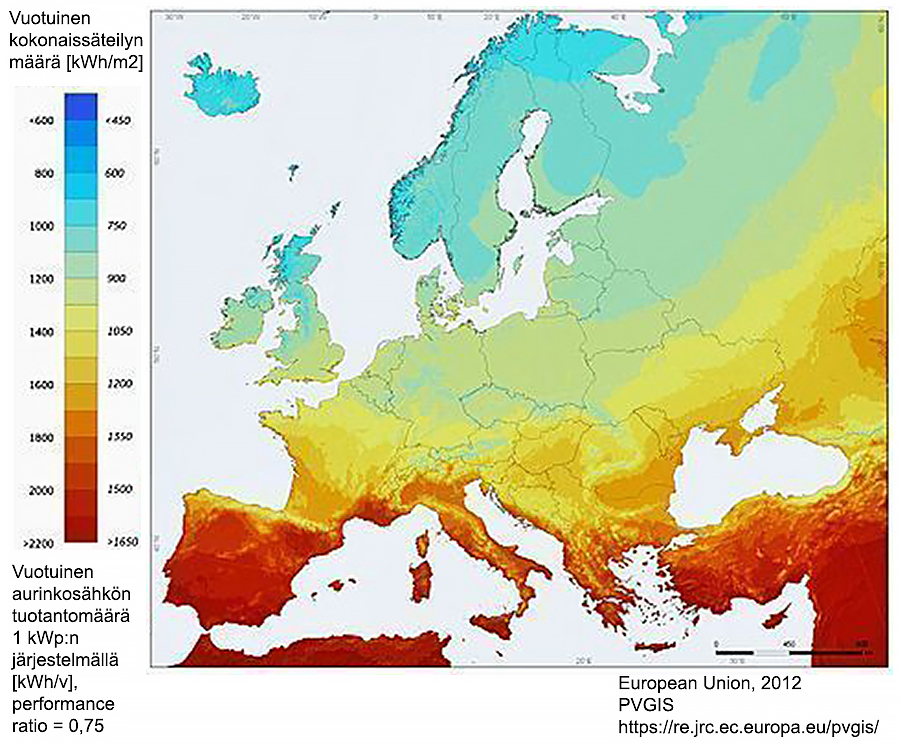
| The Finnish Meteorological Institute has developed test years describing typical weather conditions in the current climate for energy calculations. In southernmost Finland, the total solar energy for the horizontal plane is about 980 kWh/m2 per year, in central Finland about 890 kWh/m2 and in northern Finland about 790 kWh/m2, according to the Finnish Meteorological Institute’s test year. The figure below shows the average monthly irradiance at a 45 degree angle to the south-facing surface in Finland and the differences in annual irradiance between cities. 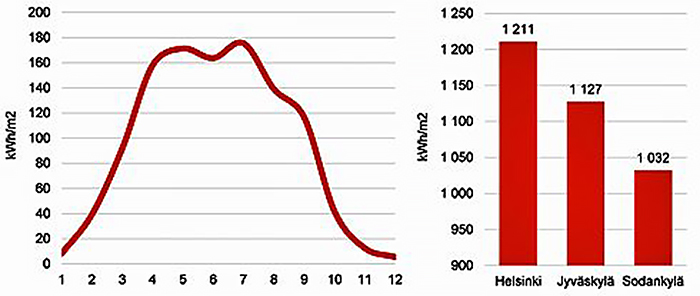 Figure 3: Sum of total solar irradiance at 45 degrees south in Finland and differences in annual irradiance between cities. Image data: Finnish Meteorological Institute. Climate data from the Finnish Meteorological Office. The Finnish Meteorological Institute measures solar radiation at several measuring stations around Finland. The Finnish Meteorological Institute’s open data solar radiation stations are located in Utsjoki, Sodankylä, Sotkamo, Jyväskylä, Jokioinen, Utö, Helsinki-Vantaa and Kumpula in Helsinki. The daily solar radiation values measured at these stations are available to all via the Finnish Meteorological Institute’s open data interface1). The solar radiation monitoring station in Östersundom in Helsinki provides real-time data on the amount of radiation in the area. |
Source: