
Bioenergy in Finland
Bioenergy is the most important source of renewable energy in Finland. Bioenergy is widely used and produced at different scales, from large forest industry plants to small-scale individual households and real estate. In recent years, regional and district heating plants have significantly increased the share of bioenergy compared to fossil fuels.
Bioenergy is used in a variety of different forms. Biomass can be processed not only into solid fuel but also into gaseous and liquid fuels. Biomass comes from a variety of sources – forests, fields and agriculture, industrial side streams and waste.
The forest industry is by far the largest producer and user of bioenergy in Finland. Efficient harvesting and logistics also enable cost-effective production of energy wood.
Although bioenergy is already widely used in Finland, there are still many new opportunities for replacing fossil fuels with bioenergy, especially in the larger buildings, regions and transport sectors. Finland is one of the European leaders in the production and use of advanced transport biofuels and their use is expected to continue to grow.
Use of bioenergy
Bioenergy is renewable energy derived from different types of biomass: wood, crops and bio-based waste, for example. Bioenergy is classified as carbon neutral, i.e. it is not expected to contribute to carbon dioxide emissions. This is because the carbon released when biomass is burned is sequestered back into the growing biomass in the long term.
Replacing fossil fuels with fuels made from biomass can reduce greenhouse gas emissions and thus slow climate change. The use of biomass can also reduce other negative impacts of energy production, such as emissions of heavy metals and sulphur. The use of indigenous biomass also contributes to energy self-sufficiency and security of supply and creates new jobs, especially in rural areas.
Bioenergy includes:
- wood-based fuels
- peltobiomassat
- biogas
- biodegradable fraction of recycled and waste fuels
Wood plays an important role in overall energy production
Finland has the highest share of biomass in total energy consumption in industrialised countries, and wood plays a key role in this. In 2024, renewable energy will account for 43.5% of Finland’s total energy consumption. Wood fuels accounted for almost two thirds of Finland’s renewable energy use (Source: Statistics Finland).
The largest user of wood energy is the forest industry, which uses forest chips and the wood-based by-products and waste sludge from its processes, such as black liquor, in its energy production.
Other sources of bioenergy
So far, energy produced from field biomass, recycled fuels, bio-based fuels and biogas has played a relatively minor role in overall energy production. However, their importance is growing as alternatives to fossil fuels are sought. The slowdown in climate change and the depletion of fossil fuel reserves are increasing interest in a range of alternative energy sources.
Bioenergy will continue to play an important role
Finland’s energy and climate strategy emphasises the reduction of emissions, especially from the perspectives of cost-effectiveness, security of supply and industrial competitiveness. The electrification of energy production and the use of waste heat will reduce combustion-based production and thus also the use of bioenergy, for example in district heating.
However, the use of wood fuels will continue to play an important role, especially in the forest industry. The use of forest chips will depend to a large extent on the cyclical nature of the forest industry. Between 2021 and 2024, around 10.5 million cubic metres of forest chips per year will be used in heating and power plants.
Mainly as a result of the increased use of biofuels, one fifth of the transport sector is already based on renewable energy. Bioethanol and biodiesel are produced from sugar- and oil-rich plants, cellulose from woody plants and biodegradable waste to replace fossil fuels for transport. The forest industry, among others, is developing so-called bio-refineries, which produce biofuels from wood residues and various forest industry by-products, including biofuels suitable for transport.
With the electrification of passenger car transport, the role of liquid biofuels, biogas and new electric fuels will become more important for heavy road transport, maritime transport and air transport.
Energy from the forest
The vast majority of renewable energy used in Finland and more than a quarter of total energy use is produced from wood-based biomass.
The most traditional form of wood energy use is small-scale wood use, i.e. heating small houses and other properties with wood stoves or clapboards. The use of wood as the sole means of heating properties has declined significantly over the decades as the share of district heating and electric heating has increased, but the share of small-scale wood use is still significant. One heating application is the use of wood pellets.
Forest chips is the generic name for wood chips coming directly from the forest for energy use, regardless of where they are chipped. Forest chips are mechanically chipped wood used in automatic wood heating systems for buildings, district heating plants and in urban and industrial heating and power plants.
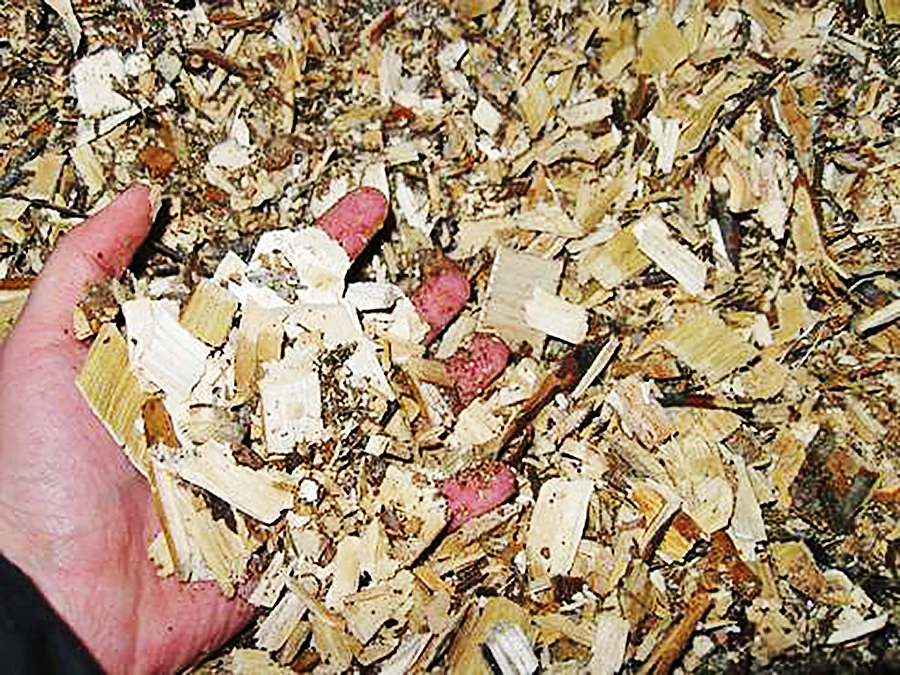
Energy wood
Wood or timber intended for energy use is commonly referred to as energy wood. Energy wood is usually wood that is not suitable for use as wood feedstock for the forest industry, including unpruned whole logs, pruned stumps, clear-cuts, tops and cuttings from end harvesting areas. Stumps are also taken from logging areas and road construction sites and crushed after clear-cutting.
Today, energy wood is considered a serious forestry resource. Integrated harvesting has improved the recovery of forest chips. In integrated harvesting, both industrial wood (pulpwood) and energy wood for energy production plants are harvested at the same time. More forest machinery and transport companies are needed to increase the use of forest chips.
Forest industry by-products
The use and production of wood in the forest industry produces energy fractions, the most important of which are black liquor, wood bark and sawdust, a by-product of pulp cooking. These energy fractions have been fully exploited as energy sources for quite some time, mainly in the industry’s own power plants and boilers, producing electricity, process steam and heat.
Recycled wood is also an important energy source. Wood products and structures can also be used as energy at the end of their life cycle.
For more information on the use of wood fuels in Finland, see the Statistics Finland database:
Energy from fields
Agrobiomass is the generic name for biomass from agriculture. The word ‘crop biomass’ is often used in the same sense, but crop biomass is a subset of agrobiomass. Other agrobiomasses include manure, spoiled feed, turnips and by-products of the food industry such as slaughterhouse waste, dung and whey.
Arable biomass refers to energy crops (e.g. cane and oilseeds) and by-products of cereal production (straw) grown in fields or on land released from peat production, which can be used as fuel or processed into solid or liquid fuels. Lake cabbage is also considered to have the characteristics of an agro-biomass.
Source: arable bioenergy production in Finland
Main energy raw materials and their use
Agrobiomass-based energy feedstocks can be grouped according to their use or origin. Their uses are constantly changing as fuel production processes evolve. In Finland, the use of agrobiomasses in energy production has so far been rather limited, mainly in large power plants.
Depending on the type of crop, arable biomass can be used for energy production as solid or liquid fuels and biogas. Solid fuels include straw, cereal grains and so-called energy grasses such as reed canary grass and lake reed.
Plants rich in sugar and starch (e.g. sugar beet, cereals and potatoes) are used to produce alcohol-based fuels such as bioethanol. Oil-rich crops, such as rapeseed, oilseed rape and flax, produce vegetable oil that can be used as a substitute for heating oil (requires modification of the oil burner and is rare). In addition, rapeseed, for example, can be esterified to produce biodiesel (RME, rapeseed methyl ester), which in turn can be used as a transport fuel as a substitute for fossil-based diesel.
Straw and cereal grains can be burned as solid fuels, for example in rural heating plants and in small houses in boilers suitable for burning them. Dry, cellulosic biomasses from arable land, such as cane straw, straw and cereal waste, can be burned as such or mixed with other fuels under certain conditions. In particular, chaff pulp is used on farms for combustion in baled form and cereal sorting residues mixed with wood chips in the farm heating plant. These agro-biomasses can also be compressed into briquettes or pellets.
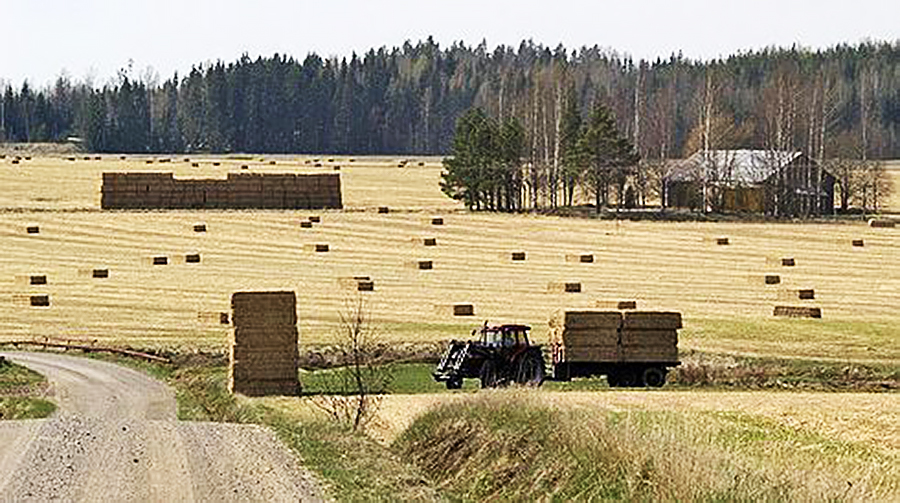
The effective calorific value of straw dry matter is about 17.4 MJ/kg, which is in the same order of magnitude as wood pellets, so the calorific value makes straw a very suitable fuel. However, the use of straw is hampered by its low energy density. A cube of loose straw weighs between 30 and 40 kg. Due to its large bulk volume, straw requires a lot of space for storage, resulting in high storage and transport costs. Straw can also be compressed into pellets or briquettes, increasing the density of the fuel and facilitating handling.
Solar power plant on a field
In the case of agricultural land that is particularly difficult to cultivate or poorly productive, it can be examined whether it would be more suitable for energy production by installing a solar power plant on the field instead of cultivation. On a case-by-case basis, the field can still be used for agricultural purposes, for example as pasture for smaller domestic animals such as sheep.
Heat entrepreneurship
Entrepreneurial heating is the local production of renewable energy, where the entrepreneur or company sells heat to the user at an agreed price. The fuel is usually wood from the entrepreneur’s own forests or from the local area, but also wood processing by-products, recycled wood and peat.
Thermal entrepreneurship promotes local business
Producing heat from wood and other biofuels provides local employment and reduces oil imports. It is also an economical and environmentally sound way to produce heat.
In addition to the purchase of fuel, the entrepreneur operates the heating plant and receives income from the energy produced for the property to be heated or for the heating network. Heating plants can be owned by the property owner or the entrepreneur, with a capacity ranging from a few hundred kilowatts to several megawatts.
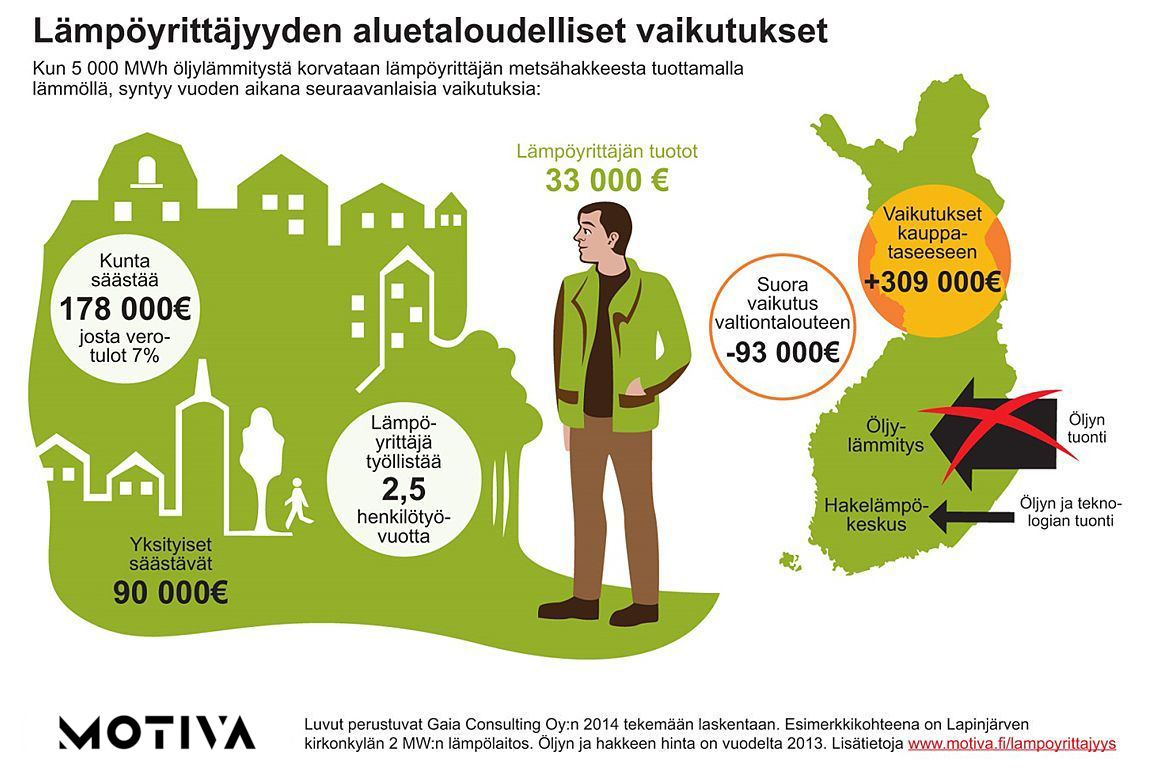
The heating business has started with small oil-fired heating plants, which have been converted to woodchip heating by a heating entrepreneur. Initially a sideline business, it has now become the main activity of many entrepreneurs.
The buyer of the heat is usually the municipality. Wood energy offers municipalities and cities a local energy option, using local energy resources and the services of local entrepreneurs. In this way, the cash flows from the heat business support the economic development of the local community.
In addition to municipalities, heat is also increasingly produced for business use.
Source: TEM Industry Report (1/2023) Renewable energy – towards a carbon-neutral future
Map. Heat entrepreneurs on map – incl. those who have given permission for publication. Source: Heat Entrepreneurship and Renewable Energy (TTS)