
Heat pumps
Air-source and ground-source heat pumps are becoming increasingly popular. Depending on the type of heat pump, heat energy is extracted from the outside air, the exhaust air from the ventilation duct of the house, water, soil or rock. The heat extracted from outside the house is mainly energy from the sun, with the exception of the heat from the bedrock, which is mostly heat from the Earth’s core.
Heat pumps save energy, the environment and money
Heat pumps deliver significant financial savings and environmental benefits in a wide range of buildings. According to a survey commissioned by Motiva in 2017, investments in heat pumps in housing companies were driven by the need to reduce energy costs and increase the resale value of the property. Around half of the respondents said that investing in a heat pump had also reduced the company’s rent. The installation of heat pumps in housing companies has therefore become more common in recent years.
Sales of heat pumps have also been boosted by the long period of low interest rates on loans and the possibility of benefiting from the homeowner’s allowance for renovation projects. Increasing concerns about climate change may also boost heat pump sales.
Heat pumps significantly reduce environmental pollution
At national level, the energy savings achieved by heat pumps contribute to a reduction in CO2 emissions from electricity consumption and in fine particulate emissions, which are harmful to health. The purchase of a heat pump is therefore an important environmental act. From the point of view of CO2 emissions from energy production and other environmental impacts, the investment in a heat pump makes most sense for buildings with electric and oil heating.
Heat pumps put the brakes on rising heating costs
Energy prices have risen by a few percent per year over the long term. With a heat pump, the absolute increase in energy costs is much lower. The purchase of a heat pump puts a brake on the increase in the cost of heating a property, and heat pumps can reduce energy costs even more effectively when combined with control systems that track the price of electricity on the exchange and possibly with energy storage and even seasonal storage of heat.
Technologies of the future
The importance of heat pumps will increase in the future as demand response needs grow. The more renewable electricity is generated from solar or wind power, the more the electricity market will need to be flexible at times when weather-dependent energy is scarce. This will directly benefit those who generate their energy with heat pumps, as heat pumps can be used to help store energy when demand is low. In turn, the energy stored by heat pumps can be used when energy prices are high, i.e. when demand is high. Demand response opens up further savings opportunities for the heat pump owner.
Selection of heat pumps for different applications
In principle, all different heat pump solutions are suitable for a particular application. Often, for rational reasons, more than one type of heat pump can be chosen for the same site or several different types of heat pumps can be chosen for the same building. Choices often depend on factors such as the heat distribution pattern, the temperature level of the potential radiator network, the energy demand, the geographical location of the building, the building’s function, the potential cooling needs of the building, local energy prices, the plot of land, permits and other considerations for buildings of different sizes.
The principle of heat pumps
Heat pumps work in a similar way to refrigeration appliances, taking heat from food and transferring it outside the refrigerator. A heat pump works in a similar way by collecting heat stored in soil or water and transferring it inside a building.
Heat energy is recovered by means of a heat exchanger (evaporator) for the refrigerant circuit of the heat pump. The thermal energy is transferred with the refrigerant to a compressor, which compresses the refrigerant vapour under high pressure, returning it to liquid form and the high temperature generated is recovered in the condenser.
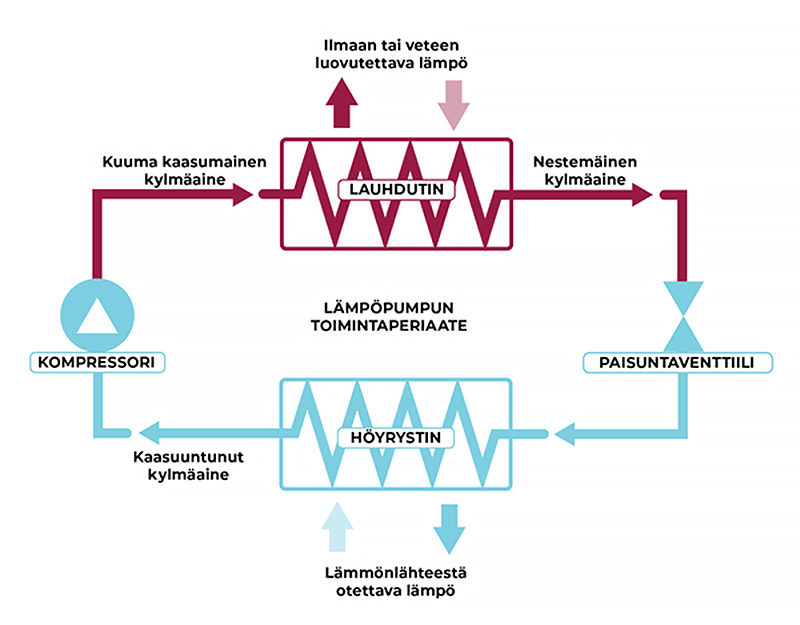
Heat pump technology has evolved in recent years and new equipment can collect heat from colder places and transfer it to hotter ones. The efficiency of the equipment has also improved. In extreme cases, some units can collect heat from -20 to -30 degrees Celsius and use a compressor to raise it to +60 to +70 degrees Celsius. However, at these extreme conditions, the efficiency of the heat pump is already poor and the output is quite low.
The coefficient of performance describes the efficiency
The efficiency of a heat pump is described by the coefficient of performance, which tells you how much more heat the appliance produces compared to the amount of electricity it consumes. For example, if the heat pump has a coefficient of performance of 3, the efficiency of the appliance is 300%. The heat pump then produces 3 kWh of heat for every 1 kWh of electricity it uses for transmission.

A heat pump achieves the best thermal efficiency and profitability when the temperature difference between the heat collection and heat dissipation is as small as possible. In this case, energy is collected from the warmest possible source (e.g. a heat well) and heat is transferred to underfloor heating instead of the radiator network.
In a zero-energy house, geothermal underfloor heating can achieve high efficiency in space heating. A zero-energy house also requires significantly less heating energy than a so-called standard house. This is because passive houses can be heated at a very low circulating water temperature – underfloor heating can be as low as 25 °C.
The coefficient of performance for domestic hot water is always slightly worse than for space heating. With some heat pumps, the domestic water temperature also has to be raised, for example by means of an electric resistance or wood heating. Heating domestic hot water in a zero-energy house may consume more energy than space heating.
New refrigerants more environmentally friendly
The refrigerants used in the new heat pumps are better for the environment than before. The fluid circulating in the ground source heat pump’s collection circuit contains about 70% water and about 30% bioethanol. The liquid circuit of the systems
Heat pump technologies
In a heat pump central heating system, heat from the ground or water is transferred from the heat room to the rooms via water or air in the same way as in oil and district heating systems. The heat is transferred through a plastic pipe loop installed in the ground, in a borehole or in water.
So-called geothermal heat pumps are usually used to heat private houses, which extract either surface ground heat, rock heat or water heat. These heat pumps can be used to heat both rooms and domestic hot water. Heat can also be extracted directly from the air, but air-source heat pumps require a parallel heating system because in severe frosts their output is low, defrost times are frequent and the unit may even shut down completely. However, using an air-source heat pump can reduce heating costs, especially in spring and autumn.
Inverter heat pumps are becoming more common
So-called inverter models are becoming more common in heat pumps. In inverter models, the speed of the heat pump is controlled according to the heat demand. This reduces the starting current peak, reduces the number of starts, extends the compressor lifetime and improves the efficiency of the heat pump. Speed control is used most in air-source heat pumps and least in ground-source heat pumps.
Class A circulators are becoming more common in heat pumps connected to the water circuit. Typically, a class A circulator has a variable speed depending on the flow resistance, which significantly reduces the energy consumption of the circulator. The best savings are achieved in a heating network with thermostats for each heating circuit.
The electronic expansion valve in the refrigerant circuit is also becoming more common in heat pumps. It allows significantly higher efficiencies to be achieved.
Heat pump control systems are evolving
Remote control is becoming more common in all types of heat pumps. However, it is often a paid extra feature, not necessarily a standard feature. It allows, among other things, to monitor the operation and conditions of the unit and to save energy through precise control of the temperature drop-out.
Connectivity for hybrid heating control or even more complex automation is becoming more common in heat pumps, and some devices have the intelligence to operate in a way that takes advantage of fluctuations in electricity prices, for example.
Geothermal and air-to-water heat pumps are available in models that use two compressors with different refrigerant circuits. The refrigerants are selected according to the conditions, resulting in a heat pump that operates at a reasonable efficiency and yet over a very wide temperature range.
Environmentally friendly refrigerants
Today, heat pumps use environmentally friendly refrigerants that do not destroy the ozone layer in the atmosphere. EU legislation has removed harmful refrigerants from the market, but new refrigerants are being developed all the time.
In addition to a refrigerant circuit, geothermal heat has a heat collection circuit (usually from a heat well) and now uses bioethanol as a heat transfer fluid, instead of the methanol used in the past. The system has a closed liquid circuit, which means that it does not emit any emissions into the environment.
The efficiency of a heat pump is most affected by the temperature difference between the evaporator and the condenser. The efficiency is also affected by the efficiency of the heat exchanger.
The types of heat pumps are:
Heat pump procurement guide for housing companies and municipalities
Motiva’s 2018 guide to purchasing heat pumps provides tips on how to prepare for, plan, and compete for a successful heat pump purchase. The guide also provides information on the suitability of different heat pump solutions for different applications, as well as information on factors affecting the profitability of investments.
Heat Pump Purchasing Guide for Municipalities and Housing Companies
The material for the Heat Pumps pages of Motiva’s online service has been compiled in cooperation with the Finnish Heat Pump Association SULPU, Scanoffice Oy, Rototec Oy, Nivos Energia Oy, Nibe Oy and Onninen Oy.

Teemu Kettunen
Expert