
Solar Heating
Solar thermal energy is an emission-free and renewable heat source. It is suitable for space and domestic hot water heating in both detached houses and housing associations.
Solar heat can be used both actively and passively
Passively, light and heat from the sun are directly harnessed without the need for separate equipment, and the heat is stored in the building’s structures. This requires a building site where the majority of the building’s windows can face south without shading. Passive solar energy recovery also includes solar shading by means of a shading structure or blind. In winter, the low level radiation reaching the interior heats the space, but the shading reduces the heat load in summer.
In active recovery, solar radiation is converted into thermal energy by solar collectors. The energy is usually stored in a water storage tank, but it can also be connected to other water heating systems or to the district heating network. Solar thermal energy can also be used for other hot water applications, such as outdoor pool heating. The heat transfer medium for solar collectors can be air as well as liquid.
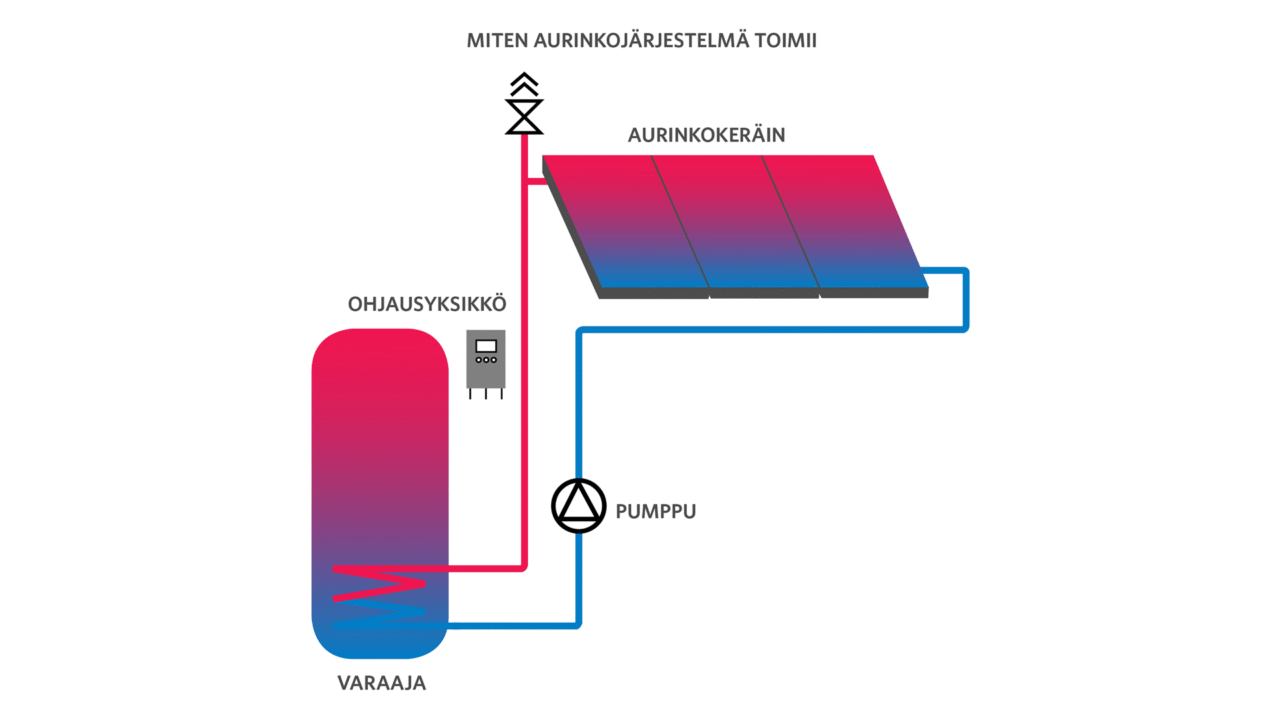
What to consider when buying a solar thermal system?
The purchase of a solar thermal system starts with a survey of energy needs and intended use. The correct sizing of the system is a key factor in the profitability of the purchase. A typical small house system has 4-8 collector fields if only domestic hot water is heated and 8-12 collector fields if solar thermal energy is also used for space heating.
In Finland, the highest annual yield is obtained by orienting the collectors to the south and at an angle of about 45 degrees. If you want to maximise yields in summer, choose a more gentle angle. If solar heat is used for space heating, it is advisable to increase the yield in spring and autumn. In this case, the collectors are raised to a more vertical angle.
As wind cools the collectors and increases losses, they should be placed in a sheltered location. Often a suitable shady and warm place can be found on the roof of a building. On open plots, collectors can also be installed on the ground or on the wall of the house. The collectors can also be installed as part of the building envelope, thus forming a wind and waterproof building element that can be used not only for energy production but also as a water roof, windbreak, facade cladding, balustrade or noise barrier. The collectors should also be placed as close as possible to the storage tank to minimise heat transfer losses.
Before installing the collectors, the durability and condition of the roof structure must be checked. Snow and wind loads must also be taken into account. If possible, it is advisable to install the collectors at an angle that minimises snow retention or in a location where snow can be easily removed. At the same time, check how the collectors can be physically attached to the house structure. Permitting procedures for the installation of solar collectors may vary depending on the type of building and the type of installation. It is always advisable to check in advance with the municipal building inspectorate.
Solar thermal systems
In solar thermal systems, it is almost always necessary to have a thermal store. Heat is usually stored for a few days to compensate for intra-day and weather-related temperature fluctuations. In smaller applications, such as detached houses, solar heat is usually stored in water storage tanks, floor structures, in the ground or in a heat well in the ground. In air-cooled systems, heat is often stored in structures.
The heat transfer fluid for solar collectors can be either liquid or air. In liquid-cooled collectors, heat is transferred to the application or to the heat exchanger by means of a liquid. Liquid-cycle collectors can be divided into two main types: flat plate collectors and evacuated tube collectors. The circulating fluid used in the collector is usually antifreeze, although water has much better heat transfer properties than other fluids. Water can be used as circulating fluid in systems where there is no risk of freezing. Otherwise, components in contact with the outside air should be drained when the outside temperature falls below 0 °C.
In air-cooled collectors, heat is transferred by air.
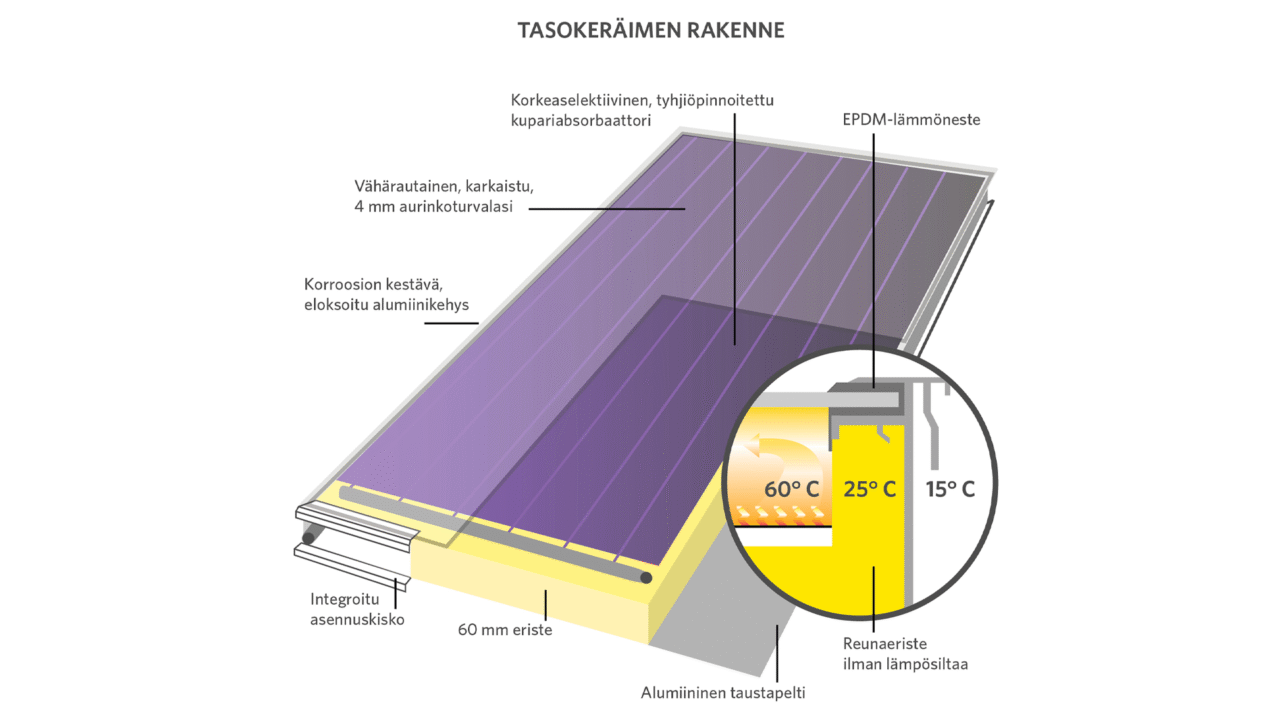
Flat Collectors
In flat collectors, radiation is collected by a dark collector element. In these, almost the entire surface of the collector absorbs the radiation. The dark surface of the element absorbs most of the radiation falling on it and gets hotter. The element is usually of metallic construction, but heat-resistant plastics are also used, especially in the case of roofless collectors.
Vacuum Tube Collector
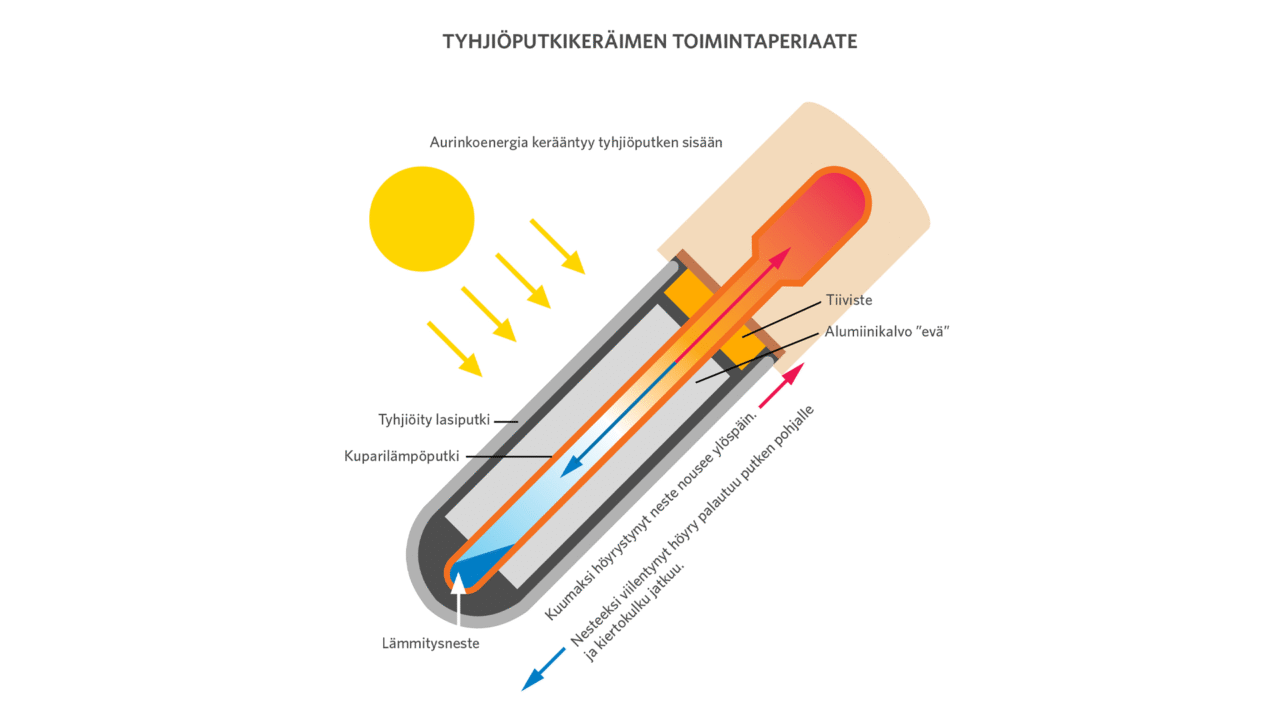
The vacuum tube collector is almost completely deaerated, significantly reducing conduction losses and maintaining a higher efficiency than the flat plate collector at high operating temperatures. The vacuum in the glass tube acts as an effective thermal insulator, effectively preventing heat from escaping back to the outside air, so that more of the heat can be recovered. As a result, vacuum tubes can have a higher heat output than flat plate boilers, especially in cold seasons. In warmer seasons, there is not much difference between the heat outputs of flat plate and vacuum tube collectors, but vacuum collectors are considerably more expensive.
The temperature inside a vacuum tube collector can reach up to 250 degrees Celsius while the surface temperature of the collector remains considerably cooler. The heat transfer from the vacuum tube to the heat transfer fluid is either through-flow or heat pipe. In flow-through vacuum tube collectors, the fluid flows either in a u-shaped tube or in a coaxial tube formed by nested tubes.
Air Collector
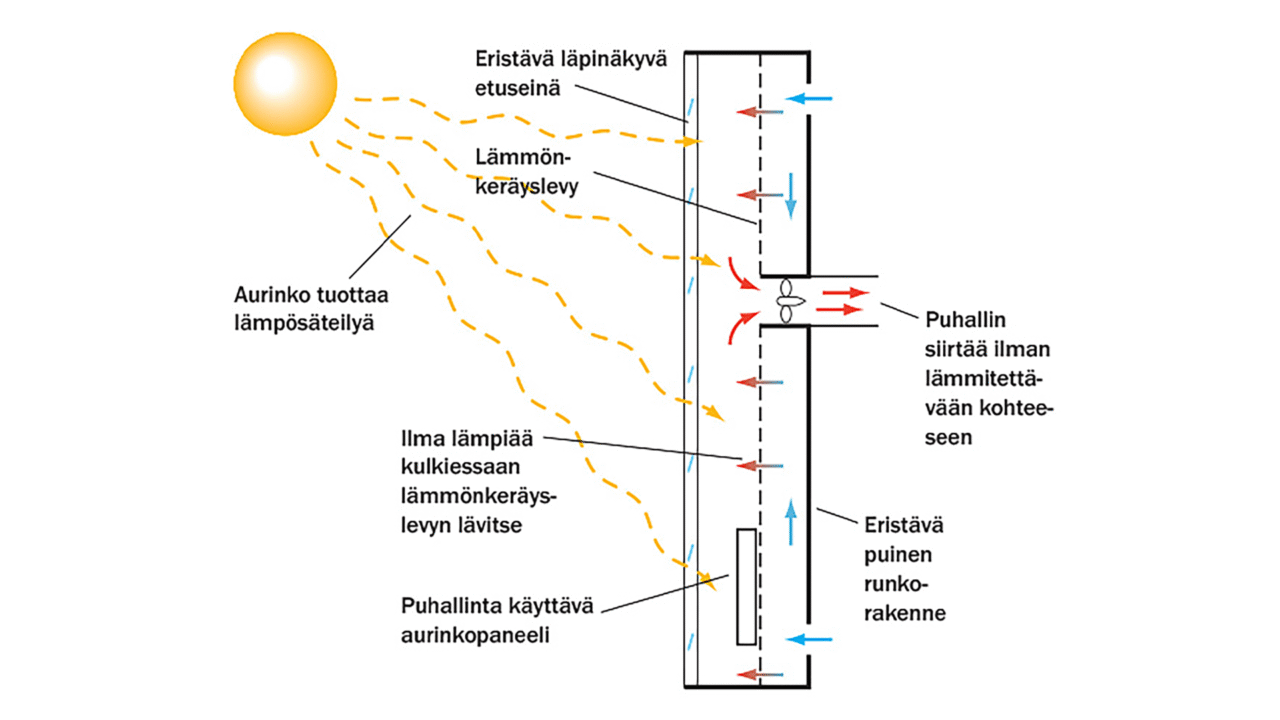
The air coil uses air as a heat transfer medium. In air circulating collectors, heat is transferred by air. The circulating fluid used in the collector is usually antifreeze, although water has much better heat transfer properties than other fluids. Water can be used as a circulating fluid in systems where there is no risk of freezing. Otherwise, components in contact with the outside air should be drained when the outside temperature falls below 0 °C.
Since air has a lower heat absorption and transfer capacity than liquid, well-performing devices are obtained by building absorption elements with a large heat transfer surface.
Connecting solar heat to other heating systems
A solar thermal system is well suited as part of the rest of the heating system as a so-called hybrid system, where solar heat is used to replace purchased energy or to store heat. Solar heating is most commonly used to heat domestic hot water, but it can also be integrated with other water heating systems to reduce fuel or electricity consumption. If solar heating is used only for domestic hot water and the system is relatively large, the surplus heat can be used, for example, to heat an outdoor swimming pool.
Direct Connection to Electric Heating
When a building is heated by direct electric heating, solar heat can be used passively for space heating and actively for domestic hot water. In this case, a solar water heater with a solar coil is used for domestic hot water instead of a conventional water heater.
Connection to Storage Electric Heating
When a building is heated by direct electric heating, solar heat can be used passively for space heating and actively for domestic hot water. In this case, a solar water heater with a solar coil is used for domestic hot water instead of a conventional water heater.
Connection to Oil Heating
It makes technical sense to connect solar heating alongside the oil boiler, as this eliminates the heat losses of the oil boiler and in summer the oil burner can even be switched off for long periods. The water volume of an oil boiler is typically around 150-200 litres, which is insufficient for solar thermal use. To store the energy produced by the collectors, a separate energy storage system is connected in parallel.
Connection to Wood Heating
Solar energy is well suited to be combined with wood or other biomass heating. Outside the heating season, the heat load from using a wood boiler in summer overheats the interior. Another advantage of combining solar heating with wood heating is that it frees up the fuel supply for heating during the summer. Solar heating is connected to wood heating according to the same principles as in the case of electric water heating.
Connection to Geothermal Heating
The solar collector can also be connected to a geothermal system to improve the efficiency and power of geothermal heating, or alternatively use the geothermal collector as a heat store, or alongside district heating to reduce district heating consumption.
Solar energy storage in a water storage tank
In solar thermal systems, the use of a water storage tank to store thermal energy is by far the most common solution. This is usually a daytime storage system, which means that solar heat is available at all times of the day during the sunny seasons and also on cloudy and rainy days.
The most common use of solar heating is to heat domestic hot water storage, which can be combined with heating of washing and sauna rooms or drying radiators. For space heating, the water from the storage heater is circulated in floor heating pipes, radiator networks or a combination of both. A mixing valve controls the temperature of the circulating water, usually based on the outdoor temperature. A hot water coil at the top of the storage tank produces domestic hot water. In case of high hot water consumption or to otherwise ensure sufficient domestic hot water, a preheating coil at the bottom of the storage tank can preheat the cold domestic hot water and thus improve the efficiency of the solar thermal system.
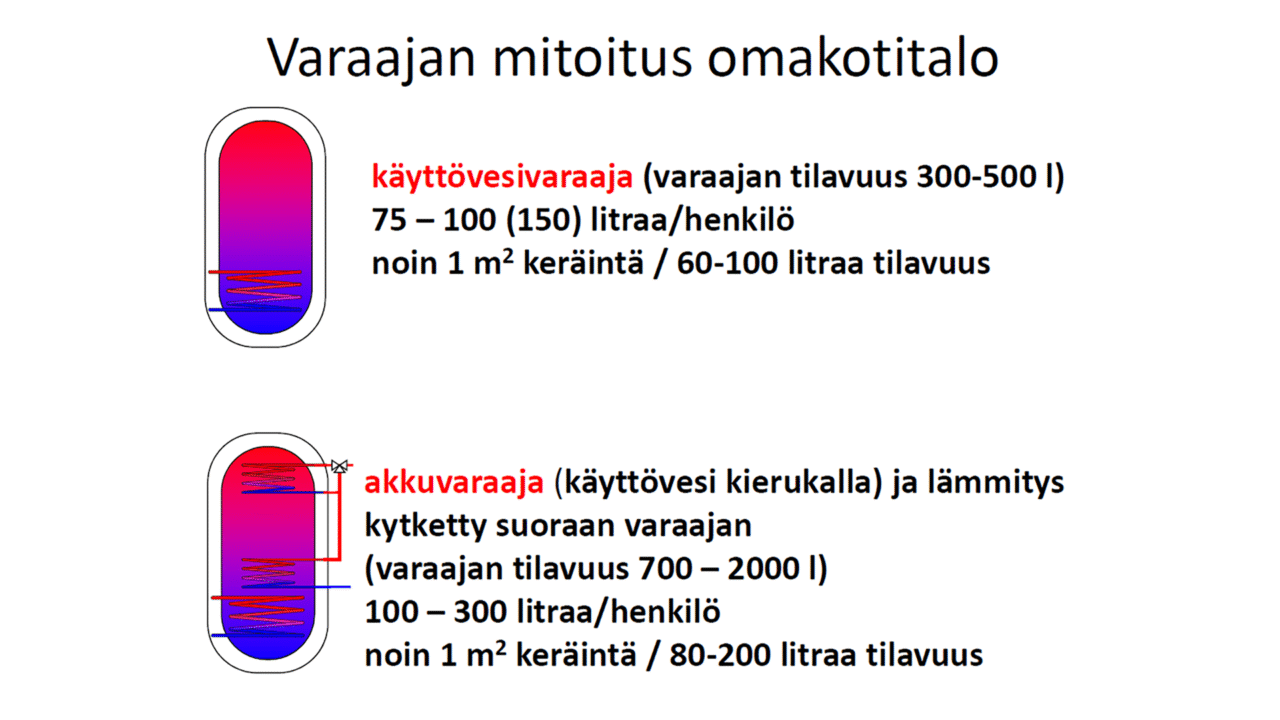
A solar collector system is often sized to cover about half of the energy needed for domestic hot water. The volume of the storage tank must be in proportion to the size of the collectors and the heat energy they produce. The volume of the storage tank should ideally be at least 100 to 1500 litres per 1.5 m2 of collector area. A larger volume is recommended if the storage tank is not unloaded daily during the summer period. A new and well-insulated 300-500 litre storage tank will have a heat loss of about 3 kWh/day. The average consumption of domestic hot water is 50 l/person/day.
Annual yield, efficiency and lifetime of a solar thermal system
The annual yield of a solar thermal system depends significantly on the type of collector, the location and orientation of the collectors installed and the sizing in relation to the heat consumption of the site. Typical production for domestic hot water is 0.4 MWh per collector m2 , while other applications, such as space or pool heating, reach yields of at least 0.5 MWh per collector m2 . On a sunny day, 2 to 3 kWh of thermal energy can be produced per m2 of collector, raising the temperature of 100 litres of water by 15 to 25 °C and 50 litres by 30 to 50 °C respectively.
Only part of the solar radiation reaching the solar collector can be used. Depending on the technology and conditions, the collector’s efficiency can be as high as more than 70%. In practice, however, the efficiency of the whole system is lower due to factors such as temperature conditions and thermal energy storage capacity. For all liquid-cycle collectors, the heat collection efficiency is higher when the fluid entering the collector is as cool as possible. This requires the lowest possible temperature in the energy reservoir or a correspondingly low return temperature to the heating network. Thus, in low-temperature applications, such as radiant floor heating, the efficiency is better than in radiator heating.
The lifetime of a solar thermal system can be estimated at around 30 years. Its maintenance cost over its lifetime is 5-10% of the initial investment. The control unit and expansion tank usually need to be replaced once and the heat transfer fluids twice in 30 years. The pump usually lasts the lifetime of the solar thermal system.
Solar thermal system maintenance and servicing
There is very little maintenance required for flat packs. However, the whole system needs to be inspected regularly and serviced as necessary to ensure that it operates correctly throughout its lifetime.
Normally, the collectors are adequately cleaned by snow and rainwater. However, solar collectors should be cleaned regularly if there are a lot of trees or other dirt or litter nearby. In winter, if you suspect that you have exceeded the permitted snow load, you can remove the snow as long as the equipment does not damage the glass surfaces of the collectors. It is also a good idea to check collector fittings, joint insulation and structural penetrations annually for possible leaks or bird damage. Similarly, the adjustments to the solar thermal system should be checked annually.
The freeze protection and the freezing point of the collector solution should normally be checked every two years to prevent the collector from freezing in winter. The pressure in the system varies somewhat with temperature, so the pressure gauge should also be monitored. If the solar collector system is not used, for example during extended periods of absence, it is a good idea to cover the collectors to prevent the heat transfer fluid from boiling. It is also a good idea to service and clean the storage tank when servicing solar collectors.