
Solar Power
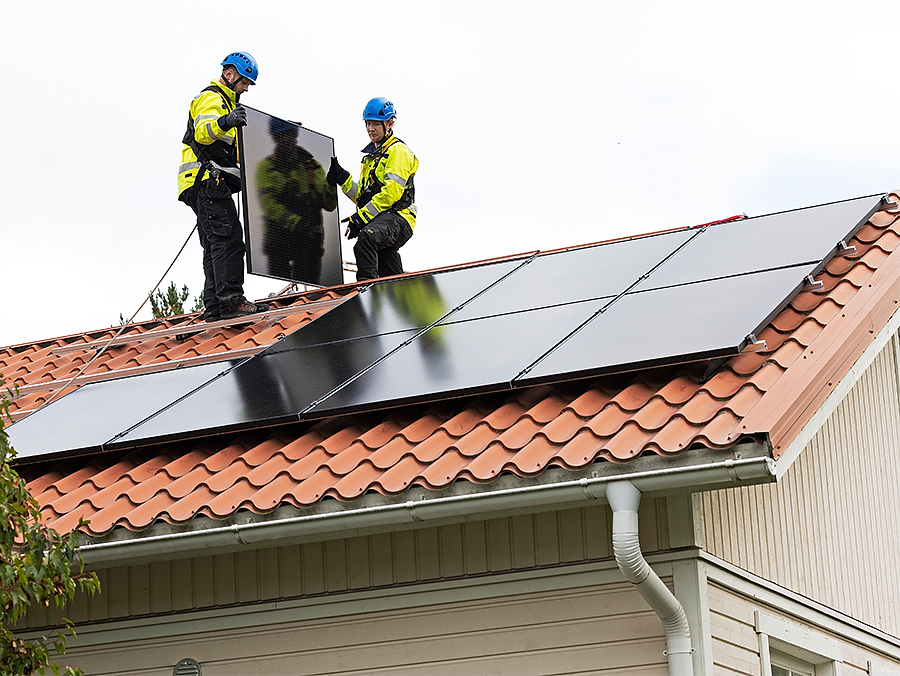
Small-scale solar power generation has grown rapidly in Finland. Its capacity in Finland exceeded 1 000 MW in 2024. On an annual basis, panels in Finland produce about the same amount as in northern Germany, but production is more concentrated in the light seasons.
Why should you buy solar power for your home or housing company?
Clean energy at a lower cost
- Solar energy production is clean and emission-free
- Does not cause noise or harmful emissions such as carbon dioxide, flue gases or fine particles
- A solar photovoltaic system can be an economically viable investment in the right location
Effortless and long-lasting
- Solar panel systems are long-lasting and require little maintenance
- After 25 years, a good quality panel will still be at least 80% of its original efficiency
- The fastest wearing part is the inverter, which also lasts about 15 years
Prepare for the future
- Small-scale electricity production reduces the need for purchased electricity. During a power outage, the PV system will not produce electricity if the system is not implemented in an island configuration.
- With home automation or consumption control, you can make efficient use of your own production, for example for charging your electric car
- You are prepared for electricity price fluctuations
Attractive also for housing companies
- It is more profitable for building companies to become solar power producers, as the revenue can also be channelled to the apartments
- As the size of the system increases, the cost-effectiveness of the procurement also improves
- Homeowner’s own solar panels increase homebuyers’ interest in the destination
Solar power has satisfied users and is also appreciated by homeowners. Solar PV can even increase the value of a property.
Where can solar electricity be used?
A photovoltaic system generates electricity from solar panels placed on the roof, wall or ground. The system is connected to the building’s electricity supply via an inverter. Any electricity that exceeds the system’s own use is fed into the national grid and paid for by the energy company that buys the electricity to the small-scale producer in accordance with the contract.
In this way, your own solar power reduces your electricity bill:
- Self-generated photovoltaic electricity reduces the need for purchased energy, thus reducing the amount of energy billed.
- in the invoicing of the electricity sales company (including VAT)
- in the electricity transmission company’s invoice (including the share of electricity tax and VAT).
- Solar electricity sold to the national grid will be credited to your electricity bill.
Small-scale electricity production for own use with solar panels has been growing rapidly, first in detached houses and then in apartment buildings. In a site well suited to solar power, a system primarily sized for self-consumption can pay for itself twice over its lifetime. However, profitability is case-specific and also depends on the evolution of electricity prices and distribution network charges.
- Panel prices have fallen and profitability is good in the right location.
- In addition to the price of the electricity produced, using your own photovoltaic power also saves you the cost of electricity transmission and taxes.
- Small-scale production increases self-sufficiency and independence.
- A photovoltaic system is long-lasting and requires little maintenance.
- Technology has evolved rapidly. Reliable and proven technology is available.
- There is a wide range of companies supplying solar power systems in different parts of Finland, so consumers can find the most suitable supplier by comparing and competing.
- Solar electricity itself is emission-free. However, the production and transport of the panels has an environmental impact.
Is solar electricity suitable for our home or apartment building?
When considering solar power for a detached house or housing association, the first step is to find out:
- How much electricity do you use? Is consumption concentrated in the light season and sunny hours, or can electricity use be directed to productive hours, for example through automation?
- Is there a suitable, sunny and shade-free space on the roof, walls or yard of the property?
- Should the roof be renovated before installing the panels?
- If you are considering a large photovoltaic system, you should check with the grid company before purchasing what capacity of photovoltaic system (inverter capacity) can be installed without having to make changes to the grid. The need to reinforce the electricity grid may cause a significant delay in connecting the PV system to the grid.
The most economical way to produce solar electricity is primarily for your own use – for domestic hot water or space heating, cooling, electric car charging, cold storage, lighting and appliance power.
In a housing company, solar electricity can be directed to both the property’s own electricity use and that of the apartments thanks to the credit metering system. This allows the size of the system to be increased, thus increasing the cost-effectiveness of the purchase.
For profitability, it is essential that electricity production and consumption coincide as closely as possible. Around 90% of annual electricity production takes place between the beginning of March and the end of September. It is worthwhile using home automation or other consumption control systems to direct electricity use to sunny hours, for example.
What can solar electricity be used for?
Solar power is well suited for applications where sufficient electricity is consumed during the light season, for example:
- The dwelling has electric heating (e.g. direct or water-cycle electric heating, heat pump) or at least the domestic hot water is heated by electricity.
- Electricity consumption is also significant during the summer for other reasons (e.g. charging an electric car).
- Solar panels are particularly well suited to cooling the home.
- A housing company needs electricity for mechanical ventilation or cooling, a heat pump, electric car charging, a cold cellar, a house sauna, a laundry room or other regular and year-round electricity consumption.
- The housing company wants to distribute the solar electricity yield to the apartments by means of a credit calculation, which requires the creation of an energy community.
This page has been produced using machine translation. Motiva is not responsible for any errors or omissions on this page.