
Air-to-water Heat Pump
An air-to-water heat pump (AHU) takes heating energy from the outside air and transfers it to the water heating system. air-to-water heat pumps are usually installed in areas where it is not cost-effective or not possible to install a geothermal system due to site constraints.
The air-to-water heat pump can also be connected to a hybrid system, for example to support an existing oil heating system, so that the oil boiler heats the house in the coldest weather, always supporting the air-to-water heat pump when needed.
An air-to-water heat pump is a good solution, especially when the horizontal piping or heat well required for geothermal heating cannot be built, or when the investment cost of geothermal heating would be high compared to the energy demand. The investment is usually cheaper than geothermal, but the investment difference depends on many factors. On the other hand, an IPPC provides significantly less free energy per year than geothermal.
The efficiency and power output of an air-to-water heat pump decrease as the outdoor air cools. The annual efficiency decreases as you move from southern Finland towards the colder temperature zones of northern Finland. In the coldest frosts, the air-to-water heat pump can also switch itself off automatically. An air-to-water heat pump therefore needs a second heating system, with a peak output equivalent to the combined peak output of the heating and domestic hot water, to support and, if necessary, cover the heating needs of the whole property.
In older houses, an air-to-water heat pump can be connected to a hybrid system, for example to support an existing oil heating system, so that the oil boiler heats the house in the coldest weather and always supports the air-to-water heat pump when needed. The air-to-water heat pump’s own electric resistors can also be used as a back-up heating system.
However, there are few days during the heating season when an air-to-water heat pump is not sufficient. In a house with an air-to-water heat pump, using wood during severe frosts is an effective way to reduce the amount of electricity you have to buy.
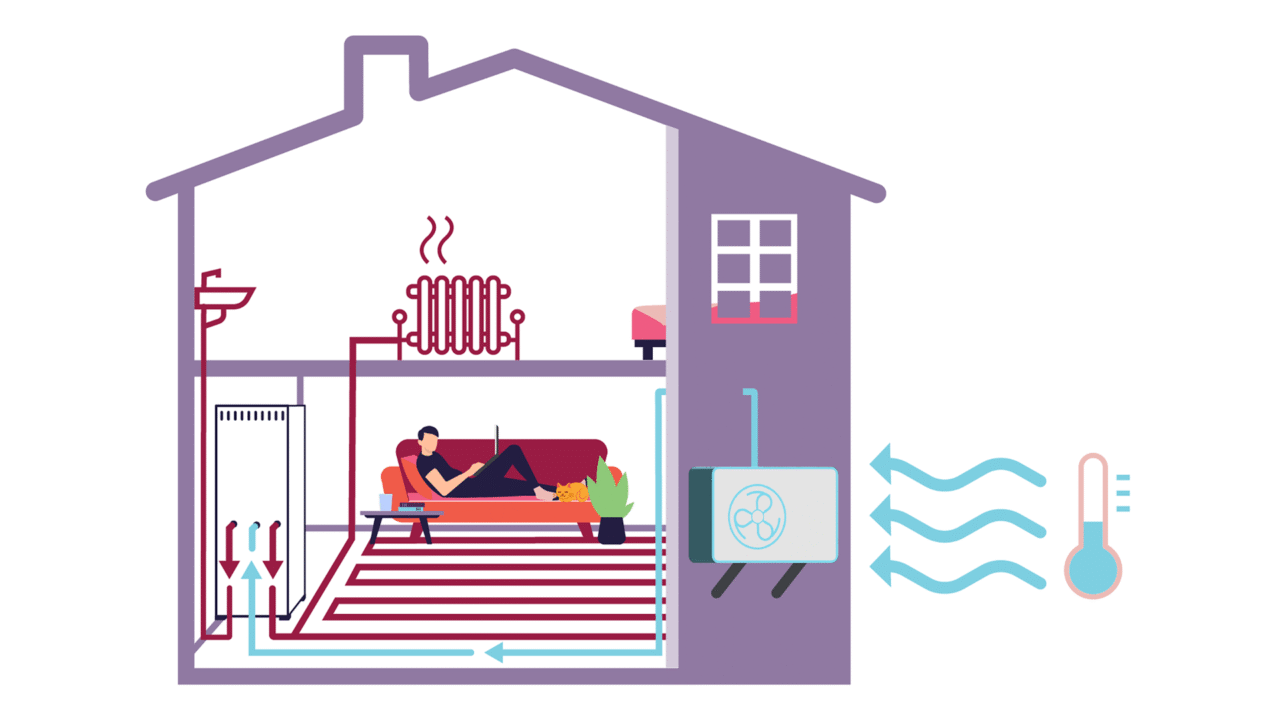
Types of air-to-water heat pumps
Air-to-water heat pumps are nowadays so-called inverter models, where the heat output of the unit is controlled by the speed of the compressor. DC control also improves efficiency, extends compressor lifetime and reduces the instantaneous peak in electricity consumption caused by compressor start-up.
There are two main types of air-to-water heat pumps:
- split equipment, and
- monoblock devices.
In split units, the refrigeration system of the heat pump is divided into two parts – an outdoor unit and an indoor unit – between which the refrigerant circulates.
In monoblock units, all the technology is in the outdoor unit, and only water circulates between the internal heaters/heater and the outdoor unit. A monoblock unit can also be connected directly to an existing heating system, for example alongside an oil boiler.
There are also indoor air-to-water heat pumps on the market. In these models, air inlet/outlet openings are made in the wall/ceiling and the unit and its storage tank are completely installed indoors. It is particularly important to follow the manufacturer’s instructions when installing these units.
Sizing and coefficient of performance of an air-to-water heat pump
High temperatures of the so-called “outlet water” to the heating network reduce the output and efficiency of the heat pump. Therefore, the air-to-water heat pump works much more efficiently for underfloor heating than for radiator heating. It should be noted that for many air-to-water heat pump models, heat output above 55°C to the space heating and domestic hot water side is problematic. The temperature is typically raised by an electric resistance in the water heater, if necessary.
There are also dual compressor models with their own refrigerant circuits, temperature ranges and different refrigerants. These models can reach temperatures above 70 °C with the output of the compressors.
At outdoor temperatures of around -15 to -30 °C, the heat coefficient and output of the heat pump are significantly reduced. In the most severe frosts, the air-to-water heat pump may also shut down automatically, so the electric resistance of the unit or another heat generator installed alongside it must be at least as high as the maximum power consumption of the house’s heating and domestic hot water. In general, the electrical resistors of the indoor unit of an air-to-water heat pump are used as a back-up heating system.
The annual energy consumption of the building and the peak power demand for heating and DHW are the starting point for calculating the appropriate sizing of the air-to-water heat pump for the building. It should be noted that an air-to-water heat pump can provide about 50% less power at -20°C than at +7°C, where the equipment’s power is usually rated (the so-called rated power, according to EN14511). Models designed for cold conditions retain their power better at higher temperatures.
If the air-to-water heat pump is too small for the site, the proportion of annual use accounted for by electric resistance may become unnecessarily high, even if the efficiency of the unit itself is high.