
Material Cycle Data Platform and Ecosystem
A challenge that needs to be solved
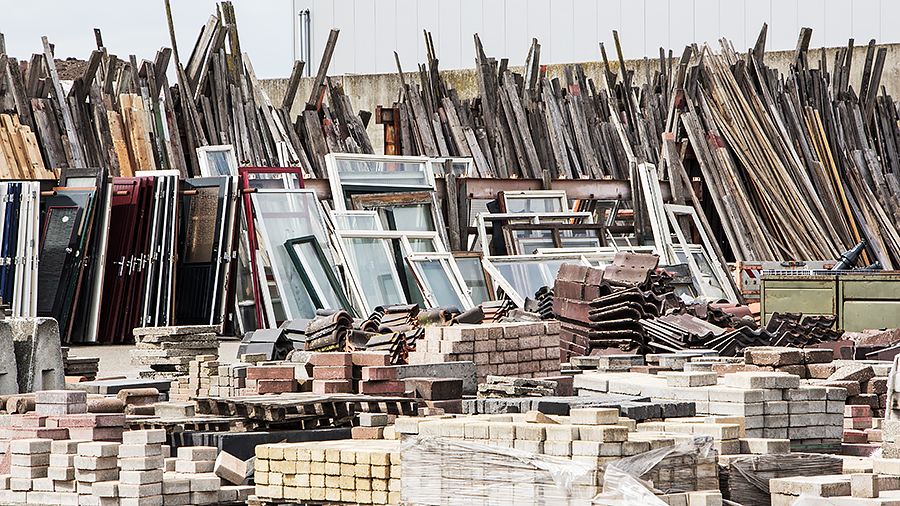
Material cycles must be made more efficient to save resources and mitigate climate change. At present, waste, surplus and side-stream materials from businesses and municipalities are not recovered because they cannot find users or recovery sites.
For example, the target for 2020 for the recovery of demolition waste from construction was 70%, but only around 50% of materials were recycled. The same challenge applies to many other sectors.
We are on the way to a circular economy, but to achieve this requires meeting material producers, handlers and recyclers, demand for recycled materials and solutions to convert waste material into raw materials. Innovation and digital solutions play a key role in the breakthrough of the circular economy.
Digitalisation to help revolutionise the circular economy
In order to efficiently recycle and generate profitable business from various industrial, construction and demolition waste streams, information is needed on the materials that can be recovered, their volumes, properties and location.
Digital platforms can act as marketplaces for materials and stimulate market creation, new product innovation and the use and development of different services.
Individual platforms and marketplaces have so far remained the preserve of a relatively small number of people. In order to improve the capacity of these platforms, interaction and exchange of information between them is needed. A circular economy platform ecosystem, connecting and aggregating platforms, can bring significant added value to the different actors in the ecosystem. Building a functioning platform ecosystem requires the integration and harmonisation of data from different sources and in different formats.
Senior Expert Paula Eskola, Motiva Services Oy“In order to enable the circulation of materials in the economy, a circular economy ecosystem and a digital platform are needed to bring together information, actors, and information platforms related to material circulation.”
A vision for a material loop platform ecosystem
The Material Cycle Data Platform makes it easier than ever to get materials into circulation. It aggregates and provides material information in a timely manner and in a format that facilitates the use of materials. For example, it will help building demolition planners to find recyclable materials or road planners to propose side streams for road structures instead of natural materials.
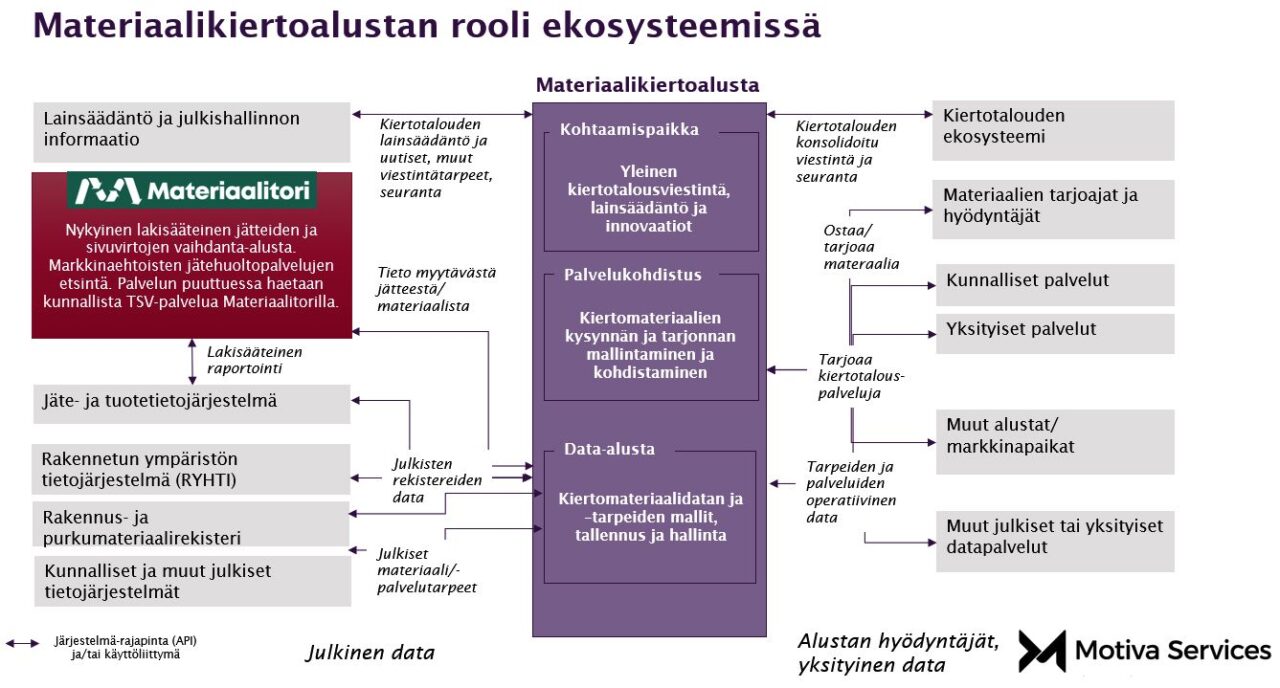
The platform ecosystem connects services to support cycles. It also provides opportunities to use information on the platform, to combine information from other databases and to exchange information between platforms. This will make information from different sources more widely available, thereby also promoting the visibility and use of platforms and marketplaces linked to the ecosystem.
The platform will also be used to collect statistical data on the progress of the circular economy, for example on recycling volumes, realised prices and the impact of material recovery on CO2 emissions.
Material Cycle Data Platform and Platform Ecosystem in a nutshell
Material cycle data platform and platform ecosystem:
- Combines, refines, and provides information from various sources, which facilitates the reuse of materials.
- Connects material users and suppliers by building a data-driven service path between them.
- Enables the interconnection of different information systems, platforms, and marketplaces.
- Measures the progress of the circular economy by producing statistical data (e.g., recycling volumes, actual prices, CO2 impact).
- Facilitates proactive planning for beneficial use.
- Provides information on usable materials in a timely manner and in the right format.
- Increase demand for waste and recycled materials.
- Help optimize material processing costs.
The design of the material circulation platform is underway
Motiva Services Oy has developed a preliminary concept and operating model for a material recycling platform, which is now being validated and developed in regional pilot projects focusing on the construction sector in Pirkanmaa and Helsinki. These projects will explore, among other things, what functionalities the service should have, how accurate information about materials is needed and what different phases and tasks the service could help with, for example in demolition projects or infrastructure construction.
In order to build the actual material circulation platform, Motiva Services is exploring options for different business models and partners to implement the platform. If the trials are successful and partners for the platform are found, it could be implemented using open source code to make the platform widely available.
Want to get involved in developing circular economy business?
The key functionalities and the concept of the Material Cycle Data Platform are to be developed in cooperation with companies, cities and other regional actors. In pilot projects, the development partners have the opportunity to influence the functionalities and needs of the service.
Principles of development:
- Open data and interfaces
- Co-development
- Agile development and iterative approach
- Transparency of results and experiments
Alongside the regional pilots, we are interested in talking to those who want to be involved in the implementation of the actual material circulation platform.
More information on development (in Finnish)
Helsingin kaupungin kokeiluhanke: Data-alustan kehitys osana Helsingin kaupungin kiertotaloustyötä
The project, which started in July 2021, will develop a model and tools for the City of Helsinki and the actors in the area under review to promote the circular economy and low-carbon goals and to identify the benefits of digital solutions and data in achieving them.
In the Vattuniemi area of Lauttasaari, 16 properties will be demolished in 2022-23.The project will develop a data-driven approach to recycling demolition materials and building components and promote material recycling at the pilot site.
The project will investigate how proactive planning can improve utilisation, the added value of centralised management of demolition mapping data and other benefits of more efficient use of data. At the same time, the concept of a materials recycling platform ecosystem will be developed to meet the needs of demolition and the recovery of recycled materials.
Pirkanmaan kokeiluhanke: Data-alustan kehitys osana Pirkanmaan kiertotalouden ekosysteemiä
The Tampere region is developing the circular economy ecosystem and in particular the use of ash. Motiva Services Oy supports this work by developing and piloting a Material Cycles platform concept to solve the supply and demand problems of ash.
The project has mapped the challenges of ash recovery from the perspective of operators, outlined the functionalities of the information platform and developed draft user interfaces for the service.
The project will not yet produce an actual technical material circulation platform, but the functionalities will be piloted by other means during the autumn.
The development work is done in cooperation with Motiva Oy, Business Tampere, Verte Oy, 1001 Lakes and Reroute.
Interested – contact us

Paula Eskola
Senior Expert